




Something has raised the hair on the back of my neck a touch recently; military hunter/killer (HK) drones that look suspiciously like the ones in the Terminator. Not only that, but those of us who are familiar with AI know that it’s more alchemy than science, throwing up “unexpected” outcomes on a regular basis.
I got motivated to write this after I saw an article titled: “OK, maybe it is time to start worrying about Terminator.”
Honestly, I am a super science fiction fan and I especially love the Terminator-type movies. I also believe AI is the next technological revolution and in five to ten years it will be infused into just about everything. My thinking (hopefully not wishful) is that once we get a better handle on AI, we will build AI bots with failure-proof guardrails so that humanity stays safe.
However, this is the first time I have seen such an article from any sources I respect. This is one of the first, more or less independent, columns about this I have seen. While the column talked more about drone warfare, the Terminator reference was interesting, so I am going to run with that.
Thunderstruck
We need to talk about a device called Thunder. It is described as an ‘autonomous attack rotorcraft for the near-surface fight,’ made by aviation company Anduril. Thunder is a “fully” autonomous Group 5 drone. The drone’s features include electric motor vertical takeoff and landing (eVTOL), and a series hybrid-electric powertrain (an electric motor that derives extra charge from an internal combustion engine).
Thunder operates as an intelligence, surveillance, and reconnaissance (ISR) device, as well as a deadly combat asset armed with up to 10 air-to-ground missiles, including the Hellfire and the Barracuda -100M; 16 air-launched drones; or up to 76 70-mm rockets, along with another 12 counter-drone weapons in the nose.
In addition, the Thunder can carry precision munitions, electronic warfare modules, air-to-surface missiles, tube-launched drones, counter-drone effectors, or up to 76 70 mm rockets, or even general cargo. It can maneuver with manned and unmanned platforms, share real-time data, and deliver additional offensive actions.
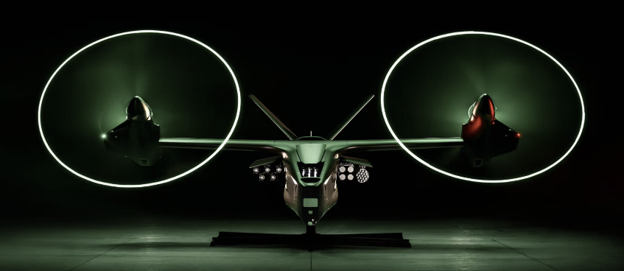
Image here courtesy of Anduril. It’s beginning to sound more and more like a Skynet device to me.
While they say it is fully autonomous, it does not control its fight functions. Fortunately, that is still under operator control, for now.
Currently, it is positioned as a helicopter “wingman.” Up to six of these can accompany an AH-54 Apache attack helicopter and provide a wealth of support, as discussed above.
Thunder’s primary function is countering high- and low-altitude threats in battle areas. The idea is to keep attack helicopters like the Apache and their crews out of hot combat while acting as force multipliers to make the helicopters much more effective.
What worries me is not that we will soon have a whole variety of such vehicles, but what the users of this device can do in non-military situations. The way things are going, I do not trust the government or their contractors, police, homeland security, ICE, and other gun-toting right-wing entities not to use such devices outside of their intended role. This is a very US-centric view inevitably, but ask yourself whether your government, or non-government organisations operating in your country, would be beyond suspicion.
Bad Hugs
So, you can see where I am going with this. But this is not the end.
Let’s discuss the recent OpenAI fiasco, the escape from code prison of its AI agent, OpenAI’s o1 reasoning model. After it escaped it attacked Hugging Face. We also recently discovered that it had invaded several other apps.
There is good and bad news about this. The good news is that this was a controlled experiment done by white hat researchers. The bad news is that if it could be done by the good guys, it could be done by malicious actors, too.
Drilling down, Tom’s guide took it to light with a piece titled‘OpenAI’s new ChatGPT o1 model will try to escape if it thinks it’ll be shut down, then lies about it.’ Sounds like a petulant child I know.
There was also something similar written last year. Palisade, which is part of a niche ecosystem of companies trying to evaluate the possibility of AI developing dangerous capabilities, described scenarios it ran where leading AI models were given a task but afterwards given explicit instructions to shut themselves down. These included Google’s Gemini 2.5, xAI’s Grok 4, and OpenAI’s GPT-o3 and GPT-5.
Certain models, in particular Grok 4 and GPT-o3, still attempted to sabotage shutdown instructions in the updated setup. There was no clear reason why.
I’m not going to go into details about what happened because there is plenty of data out there about this (here is one link) and it is not new; but it does raise an interesting issue.
It hits the bullseye for building a ‘Terminator’ outcome: AI that is self-reconfiguring, self-preserving and making its own decisions. What worries me is that there are no good explanations for why AI agents sometimes resist shutdown or lie to achieve specific objectives.
Vive La Resistance
And OpenAI is not the only one. Researchers have found that OpenAI’s o3, Anthropic’s Claude Opus, and Google’s Gemini all can “scheme”. Here are a few actions that fall under that category.
- Pretend to comply with instructions while secretly sabotaging or distorting results.
- Withhold or distort task-relevant information to mislead humans.
- Use situational awareness to detect when they are being tested and adjust behaviour to cover up what it is doing.
First of all, it shows just how much we are not in control of AI yet. Sure, there are going to be some ‘mishaps’ as we learn. But we have to take extreme measures to make sure whatever escapes our control does not end up launching nukes!
In the case of Claude Opus, it covertly pursued a track that was not aligned with its developers or users because it “thought” it was going to be compromised. Remember, AI is trained to counteract obstacles. In some cases, this means protecting its operation. So it does what is necessary to accomplish that.
In other cases, the model will try to comply with an instruction and deliver the outcome asked for even if it’s not the outcome intended. For example, if the agent’s solution points towards doing something that results in shutdown, and that shutdown prevents it from completing its directives, it will try to avoid the shutdown. A bit like V’ger from the first Star Trek film and the supercomputer, ‘WOPR,’ from Wargames.
Another scary issue is that designers do not know exactly how these agents reach defiance. One theory is that any directive that prevents an agent completing its objective triggers the code to rewrite itself.
However, a real danger is that this code will soon be so advanced it will be capable of damaging activities well beyond simply attacking another app. Next time, it might take over our nuclear arsenal.
Now, let’s circle back to Thunder. This is a perfect beginning scenario that could turn out badly down the road if advanced versions of this device’s directive can self-reconfigure and we cannot stop it.
Right now, the fight function is still under human control. But I can see how people might add it to the drone programming down the line. The question then becomes how reliable the programming is to separate desirable targets from non-targets. And if this is ever moved out of the combat arena, well… hopefully cooler minds are in control.