



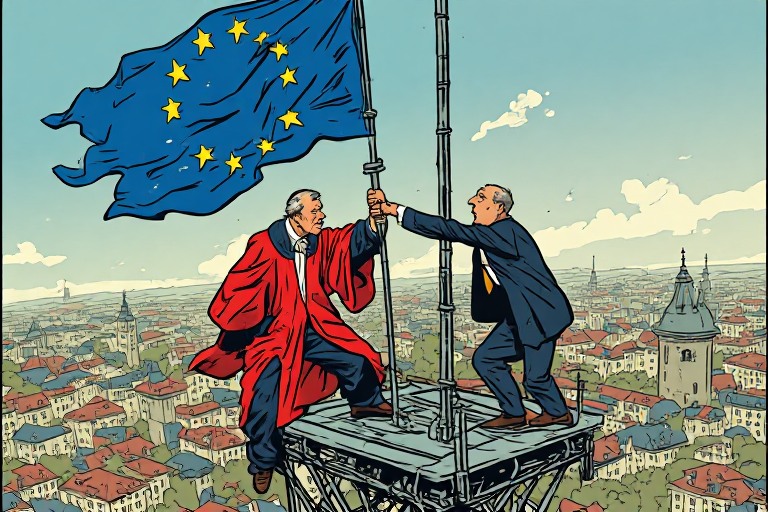
For years, the deal between European telecoms operators and the governments that license them has stayed roughly the same shape: mobile operators pay for spectrum, accept universal-service obligations, and submit to price regulation; governments treat connectivity as a public good but leave the business of running it to private companies. That deal was built for a world where the operator owned the technology stack it was regulated on. It was not built for a world where the AI, cloud and infrastructure underneath that stack is owned by two or three companies on another continent.
That is the argument Oleg Volpin, Group President, Amdocs International , has been developing. He has spent recent months examining what sovereignty means for telecoms and, in speaking to TelcoForge, was keen to emphasise that “what I’m going to share is my personal view.” . The point is a question every European operator’s board should be asking, though: does sovereignty require a fundamentally different relationship with the state than the one telecoms has had for the last three decades?
Volpin’s answer, in short, is yes… but not straightforwardly. He is not calling for renationalisation. He is calling for governments to become investors and enablers rather than simply regulators, on the grounds that operators cannot buy their way out of dependency on their own margins, and that Europe currently gives them no other route.
Chain Link
By Volpin’s count, “There are only two countries today in the world that you can call technologically sovereign. One is the United States and the other is China,” he said.
“What does it mean? They could provide you the full value chain of what you need, all with their own technology, end to end… it’s cloud, it’s hardware, it’s the harness, it’s the weights, it’s the way that they interact with the customers.”
In other words, sovereignty is not a simple technology issue but a full value chain concern; and Europe’s been realising how vulnerable it is.
“There is no cloud provider of the same size as Microsoft or AWS in Europe. There are none. Except Mistral, there are no significant LLM models in Europe, like in China and the US, where you have an endless number.”
The consequence, in Volpin’s framing, is that every “infrastructure company”, a term he uses for critical national functions such as telecoms, energy, banking and insurance, inherits a strategic exposure it did not choose.
“Every infrastructure company not able to provide sovereign services, might create a risk for its country,” he said. Telecoms, obviously, sits near the top of that list.
As an example of how concrete this point is, Volpin points to Broadcom. More specifically, what happened when it completed its acquisition of VMware, the virtualisation software that underpins large parts of enterprise and telecoms IT, in late 2023.
“The VMware acquisition shifted focus to chip development, moving away from the original purpose of VMware, which was to containerise software,” he said.
“This caused prices to triple, more or less overnight.”
If anything, Volpin’s number understates what has actually happened. The European Cloud Competition Observatory, a watchdog set up by the trade body representing Europe’s cloud infrastructure providers, has documented VMware price increases ranging from 150% to as much as 1,500% since the acquisition, and reported in 2025 that the situation had deteriorated further through the year rather than settling down. AT&T sued Broadcom in 2024 over a quoted increase of 1,050%; the case was later settled. One 2026 Cloudbolt survey found that over 80% of enterprise customers were planning to reduce their VMware dependency; a measure of how disruptive the change has been, and how difficult it still is to leave.
“Eventually what happened is the customers of VMware either had to pay double or triple prices, or find an immediate solution to their mission-critical systems,” Volpin said. “That’s how it goes. It’s quite a small example, maybe not that famous outside of the technology world, but tomorrow I could give you many similar ones with other companies.”
In fact, we have seen exactly this with the International Criminal Court in The Hague, some of whose Microsoft email accounts were disconnected following US sanctions. The circumstances around this have been debated, but the Dutch government has said the episode prompted an “urgent” reassessment of its own digital infrastructure exposure.
The mere possibility that a US company might, for whatever reason, withdraw services from clients in other countries is now something European institutions have to plan around, as do many other regions. And they certainly are doing that; in the past 18 months we have seen a variety of announcements about governments migrating from US service providers to European or open-source email and messaging services.
Quack Doctoring
If dependency is the disease, Volpin’s diagnosis of European regulation is that it isn’t treating it, it’s making the patient sicker. “I see legislation going on,” he said.
“But the key thing that I’m missing: Legislation so far is saying what you shouldn’t do. It’s not giving you any solutions.”
His complaint is a structural comment about how regulators operate. Regulation, as currently written, tells operators what to avoid without funding the alternative.
“You’re telling me I cannot use this, that and that. So you’re giving me two options: either follow your regulations, which I should if I’m a member of an EU state; or don’t follow, which is a violation. But if I follow your regulations… I will be in the Stone Age in comparison to the rest of the world.”
So what’s the solution?
“Maybe they have to say that each EU member has to pay, I don’t know, 5% of whatever tax, which will be used to build the infrastructure for you. They have to give you a means to deal with the situation. Currently, they’re just giving you what you cannot do.”
Volpin pointed out many organisations are obliged by regulators to deliver plans preparing for situations where foreign infrastructure needs to be shut off. Despite this exercise, many organisations he spoke to weren’t confident they could follow their own plans to successfully exit foreign-owned infrastructure. Rather than solving the root problem, they were meeting an additional obligation.
Volpin’s point is not that the exercise was worthless, as after all “it’s better than nothing”, but that regulation currently produces contingency documents rather than contingency capability, because it never asks who pays for the alternative infrastructure that would make the plan real.
Volpin pointed out what he sees as the structural inequality of the current telecoms-government relationship. Every few years, he argues, operators are asked to fund the next generation of network technology while government extracts value from the same process at every step.
“What’s the first thing governments are doing about it? Asking them [the telcos] to pay tax: spectrum fees, licence fees, billions of dollars. First thing, they’re taking billions of dollars. Second thing, they’re saying “Please roll out this technology to the entire country. Doesn’t matter if you have a business case.”
He contrasts this with the latitude given to Elon Musk’s satellite venture: “Nobody’s asking Elon Musk to roll out SpaceX technology where he doesn’t see the money. He will put it in the places that make sense. But the telecom operator must do it in rural areas; business case doesn’t matter, this is the obligation.”
Layered on top, he argues, is price control that leaves little room to fund anything extra: “In the majority of European countries, a cup of cappuccino is more expensive than a monthly mobile subscription.”
We could get picky here; average European mobile ARPU runs at roughly €16 a month, but the direction of his underlying point is well made. European mobile pricing has been falling in real terms for over a decade under sustained competitive and regulatory pressure, even as spectrum fees and rollout obligations have not eased.
“So how can this business afford to do something more than what it should, to generate some profit for the shareholders?” Volpin asked.
Volpin’s painting the picture of an industry that’s supposed to be a commercial venture, but acts as an extension of the state. However, he is explicit that he isn’t nostalgic for state-owned telecoms: “I’m not a supporter of state-owned companies. Private organisations are just better built to achieve efficiency. Competition is important. But there have to be ways that important industries get access to the right things to make them successful. And today, in particular in Europe, this is really not the case.”
Cash Dispenser
Volpin’s proposed mechanism is through incentives rather than interventions. They should use the thing governments already control, spectrum, as leverage for the thing they say they want, sovereignty.
“They could say “Next time you’re getting 6G, you’re not paying for licences. This is money that will go to the development of a national AI. And if you use the national AI, you’re getting a free frequency. If you don’t use national AI, you pay for it.”
“So you can incentivise; you have to find those mechanisms.”
An approach like that would be a genuinely different proposition from what most European operators have experienced from their regulators to date.
“That’s my view. But I don’t have proof that this could be successful,” he commented. However, what he does have is a live case study of what happens when the state moves too slowly to matter, playing out in almost real time.
Five years ago, the Luxembourg-based operator SES stood alongside Elon Musk’s SpaceX as one of the two largest satellite communications businesses in the world. Since then, Starlink has grown its constellation past 10,000 satellites and several million subscribers, and Amazon’s rival constellation Leo is now deploying with the backing of one of the largest balance sheets on earth.
Volpin points to what happened in parallel on the European side.
“There was a decision at European level that there is a need to invest in satellites, and there is a need for funding. And there is a process – well, it’s still a process.”
That process, the EU’s IRIS² secure connectivity constellation, only reached a finalised implementation agreement with its industry consortium in August 2026, four years after it was first proposed, at a cost that has more than doubled from an original €6 billion estimate to roughly €15.6 billion, with first satellite launches not expected until 2029 and full service only by 2032. A European Commission official put it bluntly at the signing: “We are already late, my friends.”
The ambition was correctly identified, the funding was eventually found, but the market was lost anyway, to a competitor operating on a different clock speed entirely. If sovereignty really is about to force a new relationship between telecoms operators and the governments that license them, then we have to question policymakers and regulators as much as operators how that relationship can be made to move fast enough to matter.
This is the first of two related articles. Readers can access the second on TelcoForge’s weekly newsletter. If you’re not already a subscriber, you can subscribe here in just a few seconds.
image courtesy of Perchance AI.