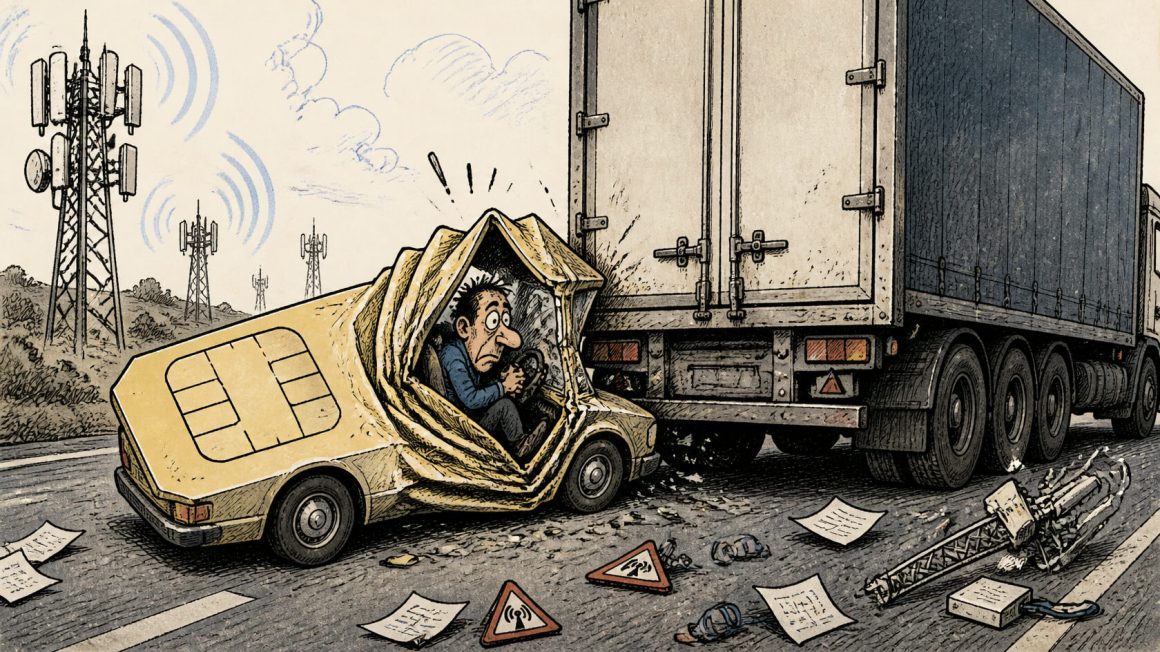
Getting a customer onto a mobile network has never been easier. “With the adoption of eSIM, we can get a customer up and running in a matter of minutes,” Ross Devereux, the new CEO of MVNE Lifecycle Software, told TelcoForge. After a fashion, anyway. “Technically you can, but there’s other things that you need to bake around the edge to ensure that that’s a safe offering to provide.”
Devereux has been at Lifecycle for more than 20 years, long enough to watch it move from bespoke, monolithic installations to modular, API-first building blocks. The customers have changed too. Increasingly, he says, they are not telcos at all. “They are the high street brands, they are the fintechs, they are anybody who’s already got an app that services millions of people.”
That is a fair description of the past 18 months. Revolut, Nubank and Klarna have all launched mobile plans, and enabler Gigs claims a branded MVP can go live in six to eight weeks. In August, we argued that the network is becoming separable from the customer relationship. However, the one thing that can’t be separated out is responsibility.
Terms and Conditions
Much of what needs to get baked in “around the edge” of a new deployment is regulation, the amount of which often takes companies unfamiliar with the sector by surprise. Compliance, Devereux said, “can’t be overlooked by MVNOs, and often it’s pushed on them by the MNOs.” Plenty of brands “will come to us with zero knowledge about what they want to do.”

The stakes are rising. Fraud prevention service Cifas recorded a 38% rise in SIM-swap attacks last year, driven by reliance on text-message passcodes. That leaves a fintech-turned-MVNO in an odd position: custodian of the very channel criminals use to break into their accounts. Ofcom has published new rules on scam messaging, and criminal offences covering SIM farms came into force at the end of October.
The penalties for getting it wrong – both from the courts and from the public – can be steep. Lifeline brand owner Infiniti Mobile lost 45% of its Lifeline subscribers in a single month after the FCC barred it from enrolling new ones over compliance violations. Whatever platform runs underneath, the regulated party is the brand on the SIM.
Power and Control
The other problem is complexity. Lifecycle’s platform is, in Devereux’s words, “highly configurable with different options for billing, for CRM workflows, for notifications.” But “with all of that comes a lot of complexity around how you actually configure that, and that’s quite daunting to an MVNO.”
His answer, perhaps unsurprisingly, is AI. TM Forum released an agentic BSS guidebook in June. Lifecycle has a proof of concept that lets a customer describe a change and have the platform make it, within “the guardrails of what we propose safe for them to do.” Devereux also sees it as a teacher: “Through their use of AI, that in turn can be the training module that’s needed.”
The problem is, a simple interface hides complexity rather than removing it, and as Joel Spolsky’s Law of Leaky Abstractions has it, all these systems that abstract away and hide complexity have failure modes. When this happens in an OSS/BSS tool, someone needs to understand what is happening underneath.
A Microsoft and Carnegie Mellon study found that knowledge workers who lack the skills to inspect an AI’s output tend not to even try. In other words, the customers who most need the AI layer to work are the worst-equipped to know whether or not it is.
Danger Zone
Lifecycle’s safeguard is a familiar one. “There’s always a human kept in the loop at all times,” Devereux explained.
Superficially an extremely reasonable position – make sure you’re not depending purely on a fallible machine. The trouble, as psychologist Lisanne Bainbridge pointed out in 1983, is that automation leaves the human with only the hardest problems and the least practice at solving them. Sociologist Madeleine Clare Elish went further, coining the term “moral crumple zone” for the human in an automated system who absorbs the blame when it fails, despite having limited control over it.
If the vendor sets the guardrails and the AI proposes the change to somebody who’s not already an OSS/BSS expert, the MVNO’s approver may be there less to exercise control than to take the blame. Rakuten’s David Soldani warned of a “control illusion” in network operations, where operators run vendor AI they cannot see into. The same illusion can operate in the BSS.
Product Liability
So can a company be held responsible for what it doesn’t control? When Air Canada argued that its chatbot was responsible for its own misstatements (and not the company it claimed to represent), a Canadian tribunal called the argument “remarkable” and held the airline liable. An MVNO will not get far blaming its platform in front of Ofcom or its subscribers.
But liability is starting to run the other way too. In Mobley v. Workday, a US court let job applicants pursue the vendor of an AI screening tool directly, as an agent of the employers using it. The ruling makes a distinction between what the vendor’s AI did and what the customer (the employers using the AI) chose. From 9 December, the EU’s new Product Liability Directive treats software and AI as products, with strict liability for defects that harm people.
Asked whether Lifecycle could share the risk its customers take on, Devereux noted that “Ideally I’d hope that we wouldn’t have to,” because the guardrails and human checks should prevent problems. But the direction of travel suggests that the more the AI decides, the more of the risk will effectively sit with the platform, whether or not anyone intends that.
Sharing is Caring
Cloud computing experienced a similar problem and developed shared-responsibility models, setting out very clearly what the provider secures and what the customer must. At the moment telecoms platforms have no common equivalent, but with increasing regulation placing liability in new places it’s something we should expect to see, either as a pre-emptive measure or in response to a court judgment that sets alarm bells ringing belatedly.
An MVNE (or, for that matter, other AI-powered platform) that made a clear offering based on what risk the platform owns, what the brand owns, what the AI may change and who answers for it has the option to turn a hidden liability into a sales argument. Devereaux already describes telling customers “That’s a fantastic idea, but is it actually viable?” The next conversation may offer more business value, even if it’s scarier – “That’s a fantastic idea, but how much of the liability for SNAFUs do you want us to take on?”