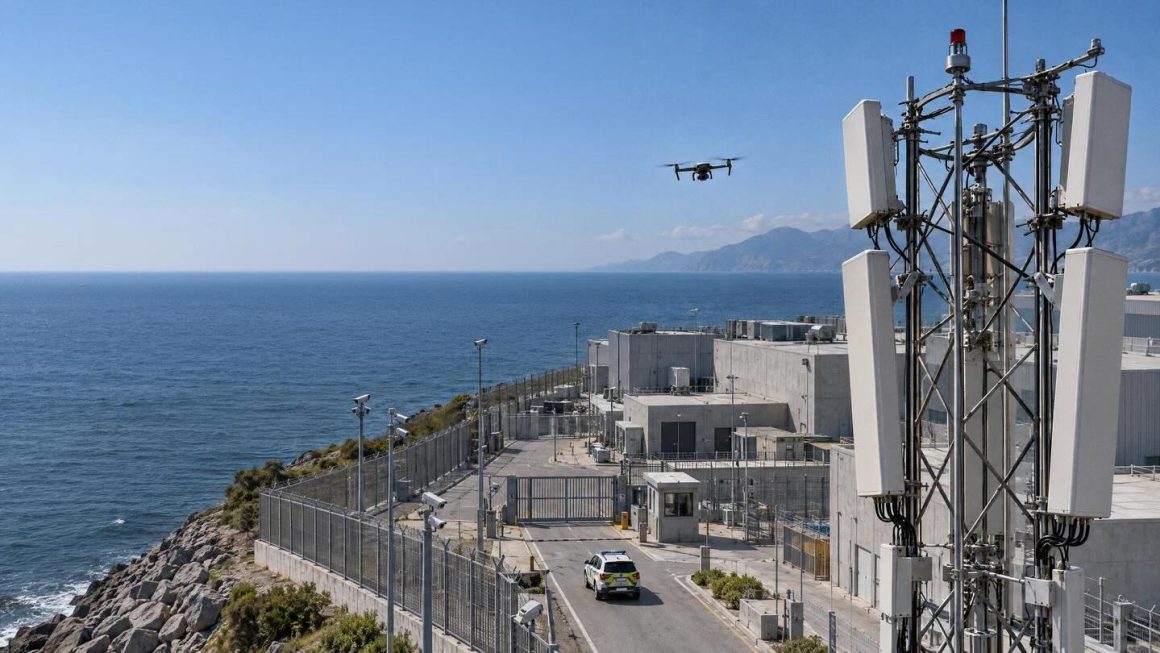
Swedish vendor Ericsson launched on Monday the Ericsson ISAC System, a solution promising to turn existing 5G sites into sensors that detect and track moving objects – including drones that never connect to the network.
According to the company, that matters because small, cheap drones have become a go-to tool for activities spanning from unlawful surveillance and organised crime to sabotage and outright warfare. The hard part is not stopping them – it is spotting them in the first place.
“Low-flying drones create a detection coverage gap that no single sensor can effectively address,” said Freddie Södergren, Global Head of Mission Critical Networks and Defense at Ericsson, in a press release.
Södergren said that the system lets several 5G sites work together to cover wide areas and follow targets continuously, feeding that data into traditional sensors and operational systems. In other words, the mobile network becomes an extra layer of situational awareness – a complement to radar, not a replacement.
While the announcement may bring excitement within the industry, Ericsson is expected to deploy small-scale, sensing-only commercial pilots with selected customers in 2027. Broader deployments will follow from 2028.
Besides, even though the acronym ISAC (Integrated Sensing and Communication) includes “integrated sensing”, the 2027 pilots will be sensing-only, and the integrated communications capability will only be added as the product evolves towards 6G.
Masts With a View
ISAC is usually pitched as one of 6G’s headline features. The principle is simple enough: radio signals bounce off objects, and a network that can make sense of those reflections can work out what is out there and where it is heading.
Ericsson’s version is multi-static, meaning the sensing signal is transmitted and received by several geographically separate sites. Watching an object from multiple angles at once, the company says, improves detection confidence, positioning, track continuity and resilience when one site loses sight.
Under the bonnet, the system pairs sensing-capable 5G radios with edge computing, AI and signal processing, reusing towers, backhaul and spectrum that operators already have. The output – tracks plus AI-based classification – can be passed through standardised interfaces to authorised security and command-and-control systems.
So, why not simply buy more radars? Ericsson’s argument is one of scale. Dedicated sensors will still matter for protecting critical sites, the company acknowledged, but stretching them across large areas would demand a lot of new infrastructure.
Seeing Is Believing?
On performance, Ericsson says validated tests showed the system reliably detecting and tracking micro drones at kilometre-scale distances, with precise 3D positioning, across different operating conditions, configurations and flight patterns.
“Kilometre-scale” is doing a fair bit of heavy lifting there, and the announcement offers no figures on detection rates or false alarms. To its credit, Ericsson admits real-world results will depend on the target’s characteristics and flight profile, the sensing geometry, terrain and surroundings, and how the system is configured.
The technology has, at least, left the lab. A trial with AT&T in Arlington, Texas, detected, located and tracked multiple drones, with their activity shown on sensing dashboards.
In Helsinki, a demonstration with Erillisverkot had several 5G sites tracking drones in support of public safety and counter-UAS (Unmanned Aircraft System) operations.
In Poland, Ericsson teamed up with mobile operator Play and Asseco, pairing ISAC with Asseco’s PUSZCZYK acoustic detection system to locate low-flying drones more accurately.
With the Ericsson ISAC System taking off, there’s a chance we can see more of it next March, at MWC Barcelona. A sneak peek into what tomorrow holds for us.
This article was written with the help of AI