



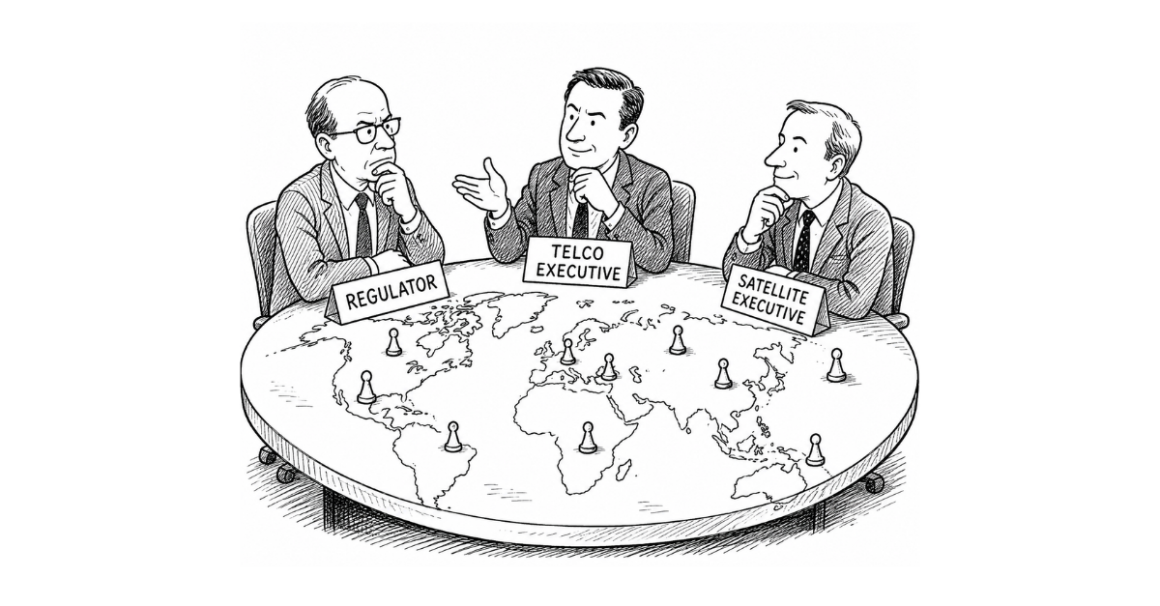
On 24 June 2026, GSMA published its Satellite Regulatory Playbook, produced in collaboration with Access Partnership.
Superficially it’s a technical document: eight regulatory pillars from local establishment rules to enforcement, all aimed at helping national regulators update frameworks built for a wholesale, backend satellite industry to cope with a retail one.
In practice it’s an attempt to answer a question the telecoms industry has circled for years: what happens when a national-scale industry has to compete with a global one?
For Michaela Angonius, GSMA’s Head of Policy and Regulation, the playbook emerged organically as the GSMA’s technology teams were already deep in satellite interoperability work:
“We had roundtables with regulators, who were saying, “GSMA, can you please help us here? This is a completely new technology in the sense that these services are being provided directly to end users”.”
It’s not unusual for regulators to want to take advice on international best practice, of course. The reassuring proposal on approach was not forthcoming, though:
“At that point of time, we didn’t really have one,” Angonius admitted.
“So we very quickly started work and we believe that, for countries that are focusing on this, it’s now the time to update their regulations.”
This is a very new area for everybody; and, although the GSMA has now built a playbook and recommendations, Angonius emphasised that the GSMA is still very much in listening mode for feedback and further refinement.
“It will be interesting to see in follow-up conversations where this work will drive us to and where it will lead to any additional work. But it’s too early to say,” she noted.
Scale Back
In 2025, TelcoForge convened a variety of senior executives to discuss why telecoms providers struggle to expand into adjacent markets. Nobody on that call was thinking about satellite regulation; but read alongside the GSMA playbook, the report arising from that conversation throws some useful context on the discussion with Angonius.
The executives’ argument was perhaps unsurprising. Telcos are limited by the very things that make them telcos, such as spectrum licences and SIM card distribution, while their real competitors increasingly aren’t bounded by anything at all.
Noted one participant: “When [operators] end up competing with others that have inherently a global market access, a global audience, they typically fail. I mean, if you build an app that works in the US, but then you compete with the likes of Google that has 5 billion people as a market, you fail every time.”
That’s the asymmetry GSMA’s playbook is built to close, coming from the opposite direction. Where TelcoForge’s panel described telcos losing to borderless rivals, the playbook is trying to stop a borderless rival behaving like one. Its central principle, “regulatory parity,” insists that, where a satellite service does what a terrestrial one does, it should carry the same obligations. What’s carrying the signal is irrelevant.
“No consumer should face reduced rights or safeguards,” the playbook states, adding elsewhere that letting satellite operate under lighter rules than terrestrial providers “would amount to a de facto regulatory subsidy and could distort investment incentives for terrestrial networks, especially in marginal and rural areas.”
Angonius pushed back gently on reading it as a competitive play. Asked whether the playbook was really about giving satellite a harder time, she was blunt:
“Tt’s really not like the mobile operators are putting a target on the back of satellite. If you read all the recommendations, it’s actually the opposite.”
Instead, she argues very reasonably that telecoms regulation is designed to protect nations and consumers. She cited a case where law enforcement lost access to communications data during a terrorist attack because the services involved were satellite-based and sat outside existing lawful-interception rules.
On the consumer side, she gave the example of a colleague with a Starlink dish just outside London who gets better broadband than she does. While for the colleague “she doesn’t really care if she’s buying something from BT or Starlink,” she definitely would care if her consumer protections weren’t the same.
Science Friction
However, the idea that satellite floats serenely above the friction caused by national regulations just doesn’t bear scrutiny, as one of our report contributors noted:
“For companies like [satellite provider], it’s a pain to go global. I mean, I meet with a woman that travels the world to try to activate services internationally. And it is a massive, massive challenge. And unfortunately, in a lot of places it has to come down to bribery to actually even get the services activated.”
That’s an uncomfortable thing to hear, but it demonstrates that satellite, and especially direct-to-device satellite, has never operated separately from national conditions. However, it has been operating in the gap where formal rules haven’t been written yet, with informal arrangements filling the space instead.
Seen that way, the playbook isn’t telcos trying to shackle an unstoppable global competitor so much as an attempt to formalise a friction that already existed.
Category Error
In the GSMA report’s market-definitions section is a category the document admits doesn’t fit anywhere: direct-to-device connectivity provided without a mobile network operator partnership.
While a “D2D-with-MNO-partnership” model slots into existing mobile licensing (the MNO stays the retail-facing, licensed party), the unpartnered model is different. It “does not fit neatly within existing mobile or satellite service categories. It has the potential to evolve into a distinct service category, requiring new or adapted regulatory treatment.” And this is where much of the meat of the recommendations sit.
There aren’t many companies that fit this model, however. Starlink’s satellite broadband product – the dish on the roof – is already exactly that model. Meanwhile, its direct-to-cell service in the US currently sits with T-Mobile as the retail-facing party. That’s structurally the partnership model the playbook says current frameworks already cover reasonably well.
That may not hold for long.
SpaceX’s roughly $17 billion acquisition of EchoStar’s AWS-4 and H-Block spectrum, alongside a trademark filing for “Starlink Mobile,” points toward a standalone retail mobile play on owned spectrum rather than T-Mobile’s. This is only gossip and speculation right now, but if it happens, direct-to-cell moves into the same unpartnered category as the broadband product.
Compare that with how AST SpaceMobile, Starlink’s most direct D2D rival, has built their model. It has signed partnerships with more than 35 mobile network operators globally, including AT&T, Verizon, Vodafone, Orange and Telefónica, positioning itself deliberately as a wholesale supplier to the industry rather than a competitor to it. Amazon’s Kuiper, still broadband-first, is following a similar approach in its early market entries.
In other words, right now, the category the playbook flags as its hardest regulatory problem describes a category of one.
None of that makes the playbook wrong to write in general, technology-neutral terms. GSMA cannot and should not draft a rule with one company’s name on it, and Angonius’s framing of the document as principle-based rather than target-based is, on its own terms, the right way to write regulation that has to survive past the current market structure.
But it’s fair to acknowledge that it’s generalising a problem that is, right now, substantially about what one company decides to do with newly acquired spectrum.
Harmony or Cacophony
If generalising a market of one sounds like a difficult mental juggling trick, there’s another tension that’s even tougher to reconcile.
The playbook insists there is no “one-size-fits-all approach,” to regulation, but in the same breath names harmonisation as one of its five founding principles.
Angonius sees no contradiction. She frames harmonisation as benefiting everyone at once: “it also obviously will help the supply providers,” she said. “So it’s a win-win.”
However, it’s unstraightforward in practice. She pointed to a conversation with an operator earlier that same day talking about international scale:
“The problem is, even if you’re able to maybe have joint core networks, or the same kind of platform that you can use across the markets to create economies of scale on the service level, because the regulation is so utterly different regardless of Europe being a single market, you cannot actually have economies of scale.”
If harmonisation struggles to take hold among regulators inside a single market, it’s fair to ask how much traction it will find across dozens of jurisdictions with wildly different regulatory capacity, none bound by anything like EU membership.
While that may sound depressing – and for many telecoms executives it really is – that same regulatory complexity can serve as a kind of competitive moat, simply by running compliance functions that under-resourced regulators and newer entrants can’t match.
Angonius doesn’t pretend regulatory capacity is even across markets. Asked whether GSMA was providing hands-on implementation support to individual regulators, she was frank that this varies by country and that GSMA’s own conversations on this were only just starting.
“In each country there is going to be unique circumstances,” she said, adding that a solution that works in one country might not work in another.
Fair enough. But it’s also, functionally, an admission that fragmentation is likely to persist even with a shared playbook in front of every regulator. Does it help accelerate the creation of regulation, applied unevenly globally? Probably. If so, it benefits end-users but means that those satellite players who have thrived in the regulatory gaps will face further slowdown and may just get stuck in telecoms’ regulatory moat.
Timing and Harmony
So, with that we have a document less than a month old, a regulator roadshow just getting under way to help circulate and refine it, and an author who twice declined, on the record, to say what comes next. There will be project-oriented people out there having a coronary about this, but Angonius is taking steps into terra incognita with this document. The GSMA’s approach in this regard is to explore and react to what they find, once they’ve found it.
An old fight in telecoms – national operators against global-scale rivals – was arguably lost with the cloud and the app economy. The GSMA’s answer to the same problem in satellite is to make the satcos (or, at any rate, satco) operate inside the same nationally-bounded rules as the telcos.
Bear in mind, this may be the right moment for such an approach.
- The GSMA is preparing separate work on network resilience, prompted by climate stress on infrastructure, undersea cable attacks, and the widening gap between what’s demanded of operators and what they’re paid to deliver it. That work will appear later in the year, but reflects a closer tie between networks and national governments, the implications of which need working out.
- Airbus recently moved its core systems out of AWS to a European cloud provider, citing sovereignty concerns. It can operate as a ‘minimum viable company’ within the EU.
- Legislation on AI is starting to catch up to the technology, insofar as there is at least some under way; and it varies depending on region.
All of these reflect a general trend towards less global and more regional or national approaches to regulation and to business in the online world. While national-scale players lost to global hyperscalers in the 2010s, it’s possible that we’re starting to see the pendulum going the other way. Companies with expertise in the regulatory and customer environment of one country may be able to act more nimbly than global players.
As Angonius might comment, it’s far too early to say. But promoting global regulatory harmonisation in this age starts to seem less like a cunning plan to hobble competition and more like charming optimism.