



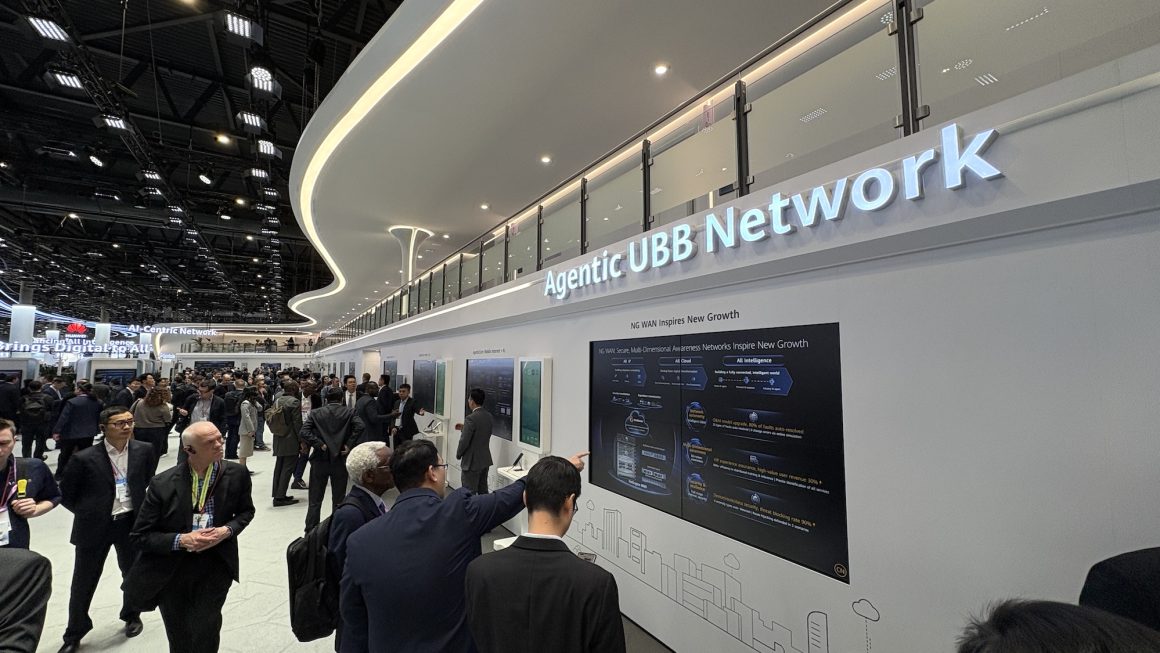
Everywhere you looked in Barcelona this year, you could see these two words: Agentic AI. At MWC 26, several exhibitors, including the big ones, demonstrated some kind of agent solution.
“We clearly saw the shift from GenAI in 2024 and 2025 to Agentic AI this year,” said Stéphane Téral, founder and Chief Analyst at Téral Research, in an interview with TelcoForge.
According to Huawei, which dedicated a good share of its massive booth at MWC to this technology, there will be around 900 billion AI agents connected by 2035.
Right now, interest is increasing: A PwC survey found that 79% of the senior executives consulted are already adopting AI agents in the United States. Another report from McKinsey revealed that 62% of respondents said their organisations are “at least” experimenting with AI agents.
“Communication Service Providers (CSPs) are looking at using AI agents tactically deployed in telecom networks to take actions on behalf of the user for network optimisation purposes,” Téral explained. “In other words, AI agents are seen as the brain of the future telecom network.”
Embedded Agentic AI
One example TelcoForge saw was Huawei’s noise-reduction solution. In this demo, users could experience a real-time call in the company’s booth and, by pressing numbers on the phone’s keypad, activate an AI agent that would reduce background noise.
Another use case the Chinese giant showcased was simultaneous interpretation. Upon calling, the AI agents translated the conversation in real time, without the need for a third-party app, all using the mobile network.
Both services presented small failures at the time of demonstration, such as difficulties in initiating the live translation; but despite those, agentic AI was there already working – and showing that this is just the beginning of what might be a revolution.
According to Téral, telcos also demonstrated their work-in-progress. “Deutsche Telekom and Orange showcased agents that, among many things, can self-optimise networks and fix routing issues in real time,” he said.
“However, both CSPs, like most of their peers, have been using self-organising network (SON) systems for RAN self-configuring and self-optimising for more than a decade. On the one hand, SON use cases are morphing into RAN Intelligent Controller and Service Management and Orchestration rApps and xApps. On the other hand, agentic AI is joining the network optimisation and energy efficiency bandwagon,” Téral added.
Grains of Salt
But not everything is bright in the realm of agentic AI. The same PwC survey noted that 28% of respondents ranked the lack of trust in this technology as a top-three challenge.
Also, while 38% of them said they trust AI agents to analyse data and generate insights, only 20% think they are reliable enough to conduct financial transactions.
Why is that? “For example, AI agents can decide to optimise something that can inadvertently negatively affect one or more other KPIs,” Téral told TelcoForge.
“You can have cascading issues caused by feedback loops: think about the disastrous effect of one agent making a mistake and other agents trusting and acting on that wrong data,” he warned.
Companies are starting to realise the risks. According to a Dimensional Research survey, commissioned by SailPoint, over 50% of respondents reported that AI agents had access to sensitive data daily.
Also, around 80% of organisations have experienced “unintended actions” from their agents, including “inappropriate data sharing and unauthorised system access.”
“To address these risks effectively, organisations must implement specialised identity security solutions with AI agent-specific controls that can restrict access to sensitive data, maintain comprehensive audit trails, and provide transparency to all stakeholders,” the report concluded.
As Agentic AI grows, the telecoms ecosystem will need to adapt and get ahead of potential threats while leveraging the power of agents to generate value. Will that pay off? The industry certainly hopes so.