



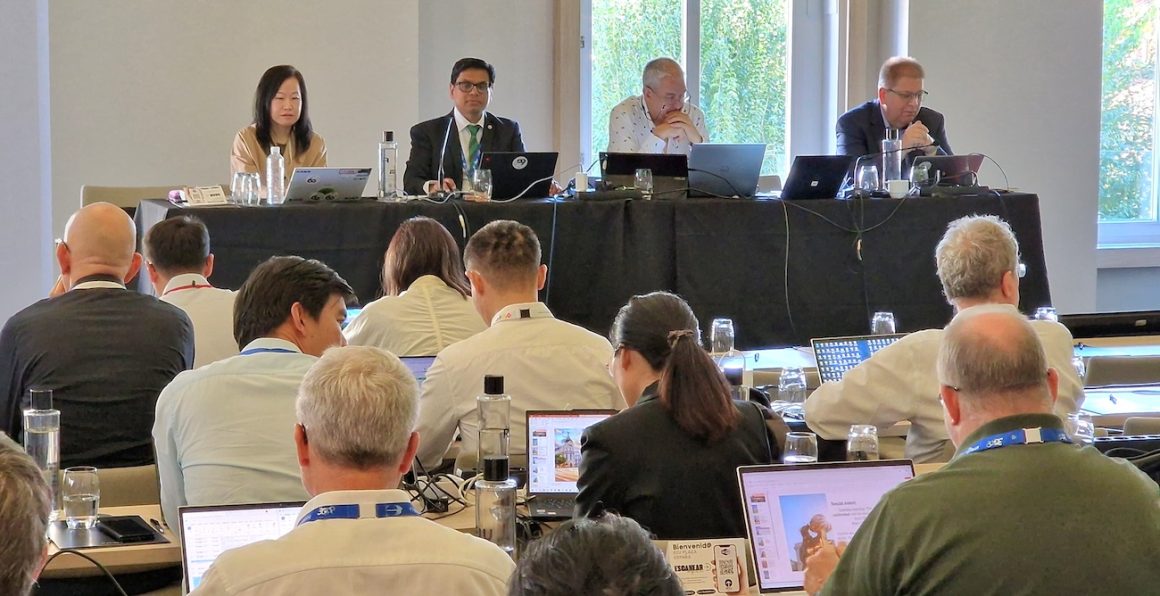
As my colleague Alex Lawrence recently reported, “it’s a daily miracle that anything gets done” at 3GPP meetings as they’re built around consensus between conflicting priorities. Last week, delegates operated the latest miracle.
The much-anticipated RAN Plenary in Madrid was expected to provide insights, among others, on the state of 6G standardisation, and the next G was indeed one of the main topics of the event.
Four working groups shared the advancements in 5G and 6G studies, each under a different perspective. Another group had already updated the 3GPP Plenary in a previous plenary.
“The meeting did achieve a few things on 6G migration options and apparently reaffirmed downlink transmission based on CP-OFDM, with uplink supporting both CP-OFDM and DFT-s-OFDM. 5G channel coding schemes are largely reused,” evaluated Stéphane Téral, Founder and Chief Analyst at Teral Research.
However, Téral noted that the advancements put the “6G” label at risk. “All of those advancements plus OFDM again as the foundational waveform, there is no need to call it 6G; rather, I call it generation LTE (GLTE) as both 4G and 5G are,” he pointed out.
Agreements on 6G
For 6G Radio (6GR), the Working Group 1 (RAN1) reported milestones reached on several topics, including uplink channel coding (BG3), constellation shaping, higher-order modulation, and aspects of 6GR Synchronization Signal Block (SSB) design. The study on 6GR is still incomplete, with discussions ongoing.
RAN2, which is responsible for standardisation of the Radio Interface architecture and protocols, also put an emphasis on 6G. According to InterDigital’s Diana Pani, the group’s Chair, RAN 2 dedicated almost half the time to discussions on the next generation of mobile connectivity.
“RAN2 does not see any blocking issue to support the non-collocated spectrum aggregation (FR1-FR2 combination) over a non-ideal backhaul (up to 10 ms),” Pani reported.
Another group to share advancements was RAN3. At the RAN Group meeting in June, the Plenary tasked RAN3 to make a decision on 6G Higher Layer Split (HLS), on whether to support 5G HLS for 6G or to introduce optimizations in Release 21.
According to the group’s Chair, Sean Kelley, Principal Standardization Lead at Nokia, the 6G RAN architecture shall support HLS, including CU-DU split and CP-UP separation, with 5G HLS as the baseline. “Optimisations that do not impact protocol distribution are not precluded in RAN3 and can be further considered in the study phase,” the 3GPP explained.
As for the 6G study, Kelley said that the group has already started 6G positioning architecture discussions, as well as the related requirements.
RAN5, the working group that oversees Conformance Testing for User Equipment (UE), advised the Plenary to “streamline testing and conformance frameworks and principles with an aim to keep testing and conformance requirements aligned with commercial deployment plans.”
According to Pradeep Gowda, Senior Director Engineering at Qualcomm and RAN5 Chair, the streamlining proposals under consideration are:
- Stricter conformance working item approval criteria, especially for feature enhancement and basket working items, tied to commercial value and deployment plans.
- Early views gathered on MU/TT shared risk principle for RF requirements.
- Split of RAN4/RAN5 RRM responsibilities (still under discussion).
It’s All About Geopolitics in 6G
Although last week’s agreements did achieve advancements towards a more unified understanding of how 6G may work, they were not necessarily the biggest news, according to Stéphane Téral.
“It’s 6Geopolitics!” Téral teased. “Geopolitics is defining 6G. 5G was ugly, 6G is even worse.”
Téral said that, as expected, debates between delegates from major Chinese operators and vendors, such as China Mobile, Huawei, and ZTE, and Western and North American counterparts centred on several key technical and strategic fault lines regarding 6G standardisation. “Then, if you just look at the West, you can see the disagreements between Ericsson and Nokia, Samsung…” he added.
Still, the analyst sees value in the outcomes of these meetings. “They’re going to get something done as usual. Let’s not forget that, despite competing commercial and regulatory priorities, the 5G lesson shows that standard 3GPP consensus mechanisms ultimately prevail and steer the group toward compromise baselines,” Téral said.
“It’s ironic because everyone touts cooperation, collaboration, and harmonisation, but geopolitics cannot be underestimated,” he concluded.