



November 30, 2022. On this day, OpenAI launched ChatGPT to the public, the first time most people heard – and started talking – about AI.
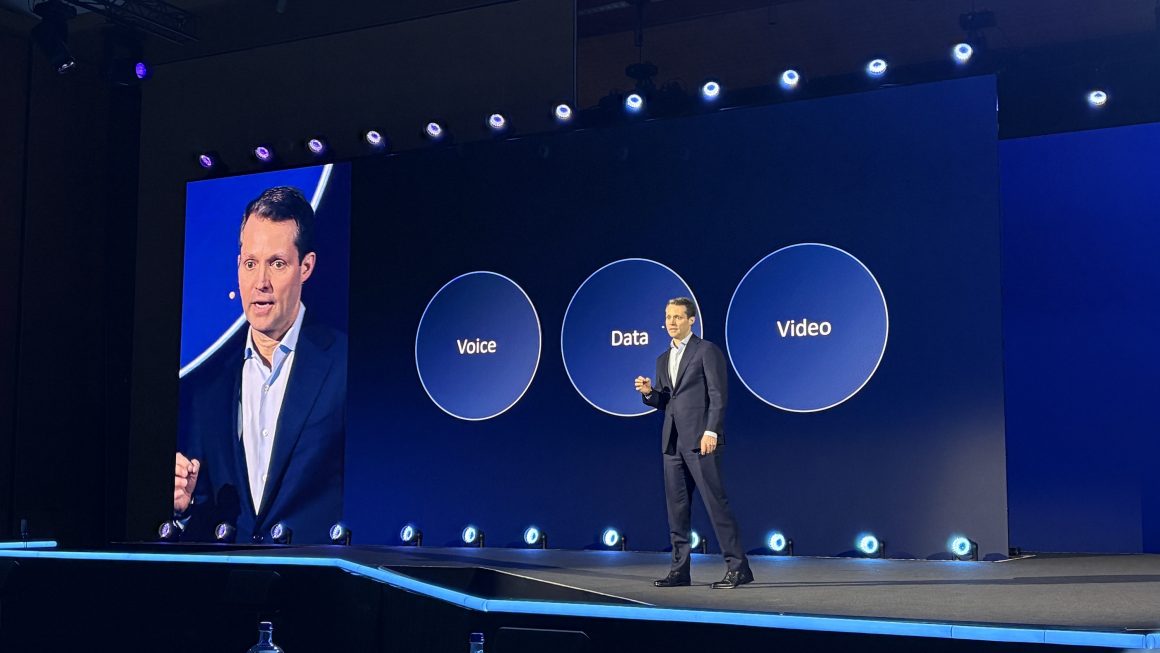
Fast forward some three years. March 1st, 2026. The recently appointed CEO of Nokia, Justin Hotard, talks to the press and analysts during a pre-MWC event in Barcelona.
“The [mobile] network is changing,” he said, after pointing out that AI moves around 100 trillion tokens per day through the network. “If it were just a question of scale, we could just do more. But AI needs a fundamental structure.”
What we’ve seen so far is human-to-machine communication using AI – chat box, for example,” he explained. But that should be about to change. “What’s coming is machine-to-machine. We’ll see a tremendous acceleration in the amount of traffic. That’s why we need a plan around networks.”
But what exactly changes with AI apart from more traffic? According to the Nokia executive, the first thing is the type of traffic.
“We’re not talking about just more capacity or uplink and downlink restraints. The traffic pattern is no longer here. Those things happen dynamically.”
In other words, the traditional mobile traffic – the one we are all used to – is more predictable: you know what to expect to hit the network. The same does not apply when AI enters the conversation: video, text, audio – anything can happen when you ask an artificial intelligence a question. The result: serious variations in data consumption.
Another outcome is a shift in the business model: from Service Level Agreement (SLA) to deterministic connectivity. “No more five nines, six nines connectivity,” Hotard predicted.
A New Set of Products for a New AI Era
If the telecoms world needs a new, AI-driven architecture, it also needs new devices to make the future happen. And Nokia had just that to announce.
Totalling seven areas (RAN, core, fixed, IP routing, DC switching, optical, autonomous network), Nokia expanded its portfolio with a clear leading motto: AI, AI, and AI. Among the novelties, the company highlighted its AI-RAN-ready Doksuri radios, promising to improve power efficiency by 30%, and to reduce installation time by “up to 70%.”
Even though, from a commercial perspective, it may sound like a “solution-looking-for-a-problem” type of situation, Hotard guarantees that’s not the case.
“This can be an investment over time, over the next seven years,” he said. “Not something for tomorrow. But you need to start planning.”
Watch Out – 6G Is Coming. Or So It Looks
While the new radios – and other components announced for MWC 26 – can be used today, the company aims for the long-term game of 6G.
“[With these new solutions] It’s not about waiting for the next G, but to innovate at the speed of the software. And by the time 6G happens, it’ll be a matter of upgrading the software. That’s the beauty of it,” Pallavi Mahajan, Chief Technology and AI at Nokia, said.
While this sounds somewhat damaging to the value of 6G, Mahajan says it does not mean we should stop thinking about the next generation of mobile networks.
“We’ll definitely need to make sure that as we head into the AI native interfaces, those are all standardised. I think a lot of times we’re talking about sensing capability now coming in. So, you definitely need that to be part of 6G,” she replied.
“What we are fundamentally saying is that we do not want to stop innovating,” Mahajan stated. “We don’t want to wait for the next generation to come.”
By the looks of it, they won’t be waiting, indeed.